PDLC vs. PNLC Smart Glass
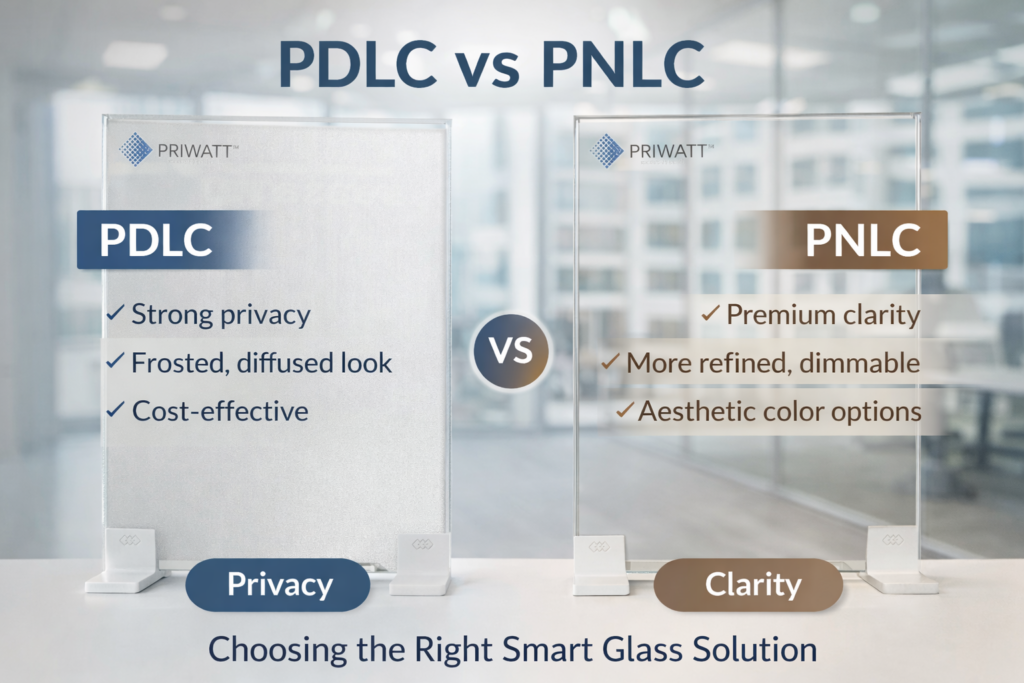
PDLC vs PNLC Smart Glass: What Architects Should Actually Know
Smart glass is everywhere now—offices, homes, hospitals, even cars.
But when it comes to choosing between PDLC and PNLC, most people either:
- get confused
- or get sold whatever the supplier has
Both technologies work.
But they are not interchangeable.
What Are They, Exactly?
1. The Real Difference
PDLC Smart Glass
- ON → Clear
- OFF → Opaque (frosted white)
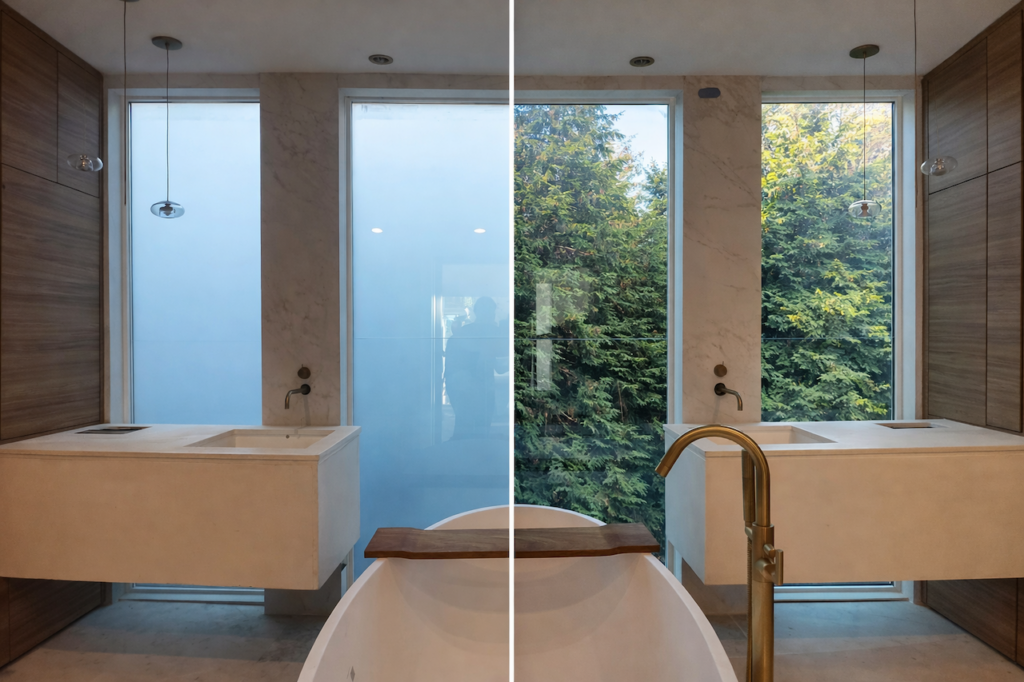
This is the standard smart glass used in most projects.
When power is off, the glass looks like frosted glass.
When power is on, it becomes clear.
PNLC Smart Glass (Reverse)
- OFF → Clear
- ON → Opaque (white / grey, bronze )
PNLC works in reverse.
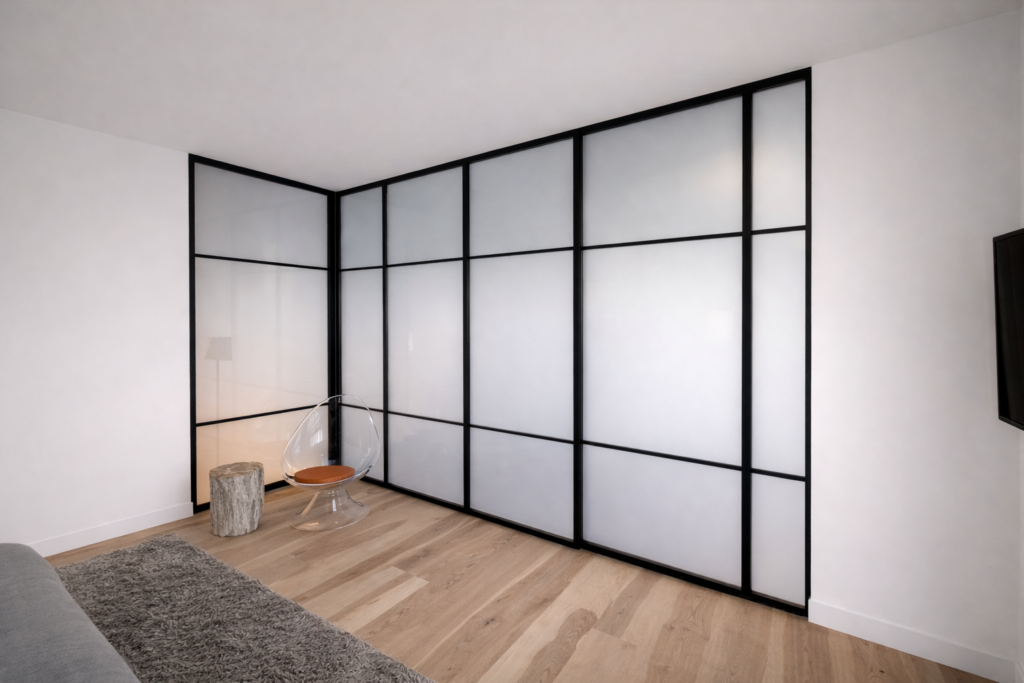
The glass stays clear without power, and turns opaque only when activated.
— ✦ —
Side-by-Side Comparison
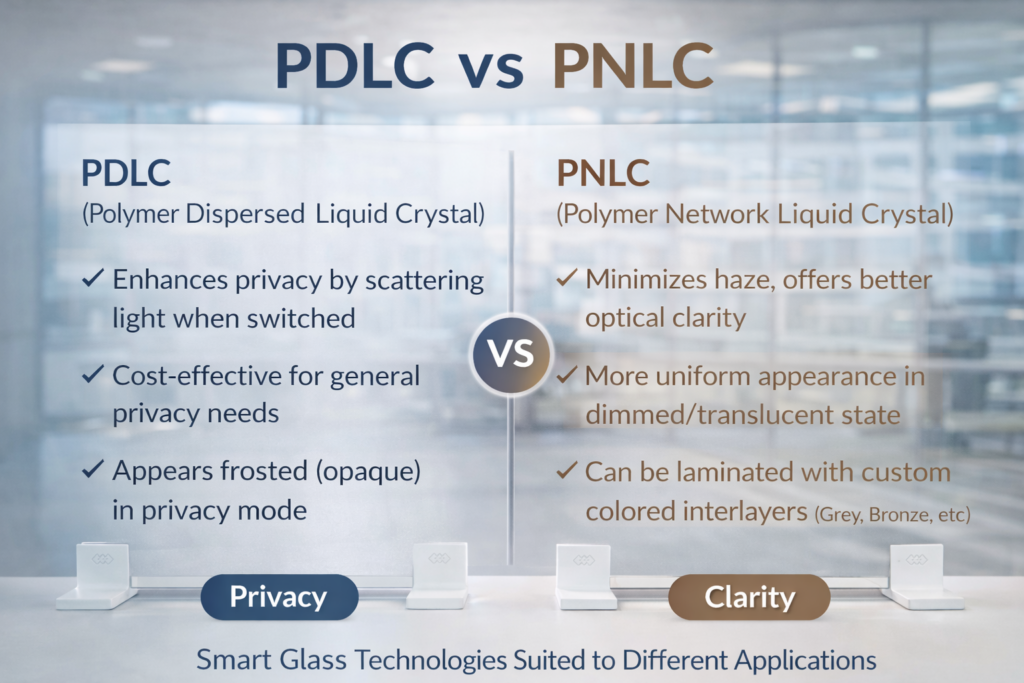
Privacy Level
PDLC
- ~98% privacy
- Strong light diffusion
- You cannot see shapes or shadows clearly
This makes it ideal where privacy is critical
PNLC
- ~93–94% privacy
- Not fully diffused
- Slight visibility of light/shapes may remain
It’s controlled privacy, not total concealment
The numbers that matter in real-world applications
| Attribute | PDLC | PNLC |
|---|---|---|
| OFF-state appearance | Milky white / translucent | Opaque — available in White, Grey or Bronze |
| ON-state clarity | Good — slight haze remains | Excellent — high optical purity |
| Haze level (ON) | 3–10% | <1–3% |
| Switching speed | 10–100 milliseconds | 1–10 milliseconds |
| Operating voltage | 40–110V AC | 5–60V AC |
| Power consumption | ~5 W/m² | ~1–3 W/m² |
| Privacy in OFF state | Moderate (diffuse scatter) | High (diffuse scatter) |
| Viewing angle | Wide but with scatter | Wide with minimal distortion |
| Cost | $60–$150/m² | $160–$220/m² |
| Available colors | White (standard) | White, Grey, Bronze |
| Durability / lifespan | Very mature technology | Excellent — proven in commercial deployments |
| Retrofittable as film | Yes — widely available | Available via PriWatt and select suppliers |
| Temperature sensitivity | Moderate | Good across standard operating ranges |
— ✦ —
PDLC in Depth
The established champion of privacy glass
PDLC has been commercially available since the late 1980s and today represents the vast majority of installed smart glass worldwide. Its maturity means an established supply chain, well-understood failure modes, and competitive pricing across a wide range of suppliers.
The technology’s hallmark is its scattering approach to opacity. When voltage is removed, the randomly oriented liquid crystal droplets diffuse incoming light in all directions — creating a soft, luminous frosted appearance that is warm and inviting. This works beautifully for privacy partitions in offices, hospital rooms, and residential bathrooms, where a diffused, glowing opacity is often the preferred aesthetic.
In the ON (transparent) state, PDLC lets in generous amounts of natural light with a slight softening effect — ideal for spaces where a bright, airy feel matters more than pin-sharp optical clarity. For most everyday privacy glass applications, this is exactly the right balance of performance and value.
PDLC Highlights
- Widely proven — decades of real-world installations
- Accessible price point: $60–$150/m²
- Available as self-adhesive retrofit film
- Soft, warm frosted appearance in privacy state
- Excellent light diffusion — reduces glare naturally
- Broad compatibility with standard glazing systems
Best Suited For
- Offices, clinics & hospital partitions
- Residential bathrooms & shower enclosures
- Retrofit applications on existing glass
- Large-area installations where budget matters
- Spaces where soft, diffused light is a design goal
PNLC in Depth
The next generation — Engineered for clarity
What Makes PNLC Different
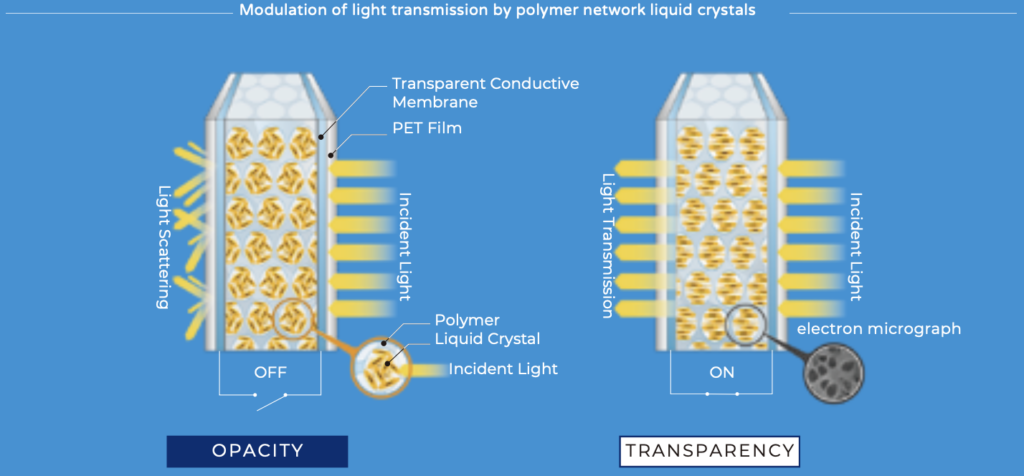
Unlike PDLC, which uses dispersed droplets, PNLC forms a continuous polymer network. This allows for more controlled alignment of the liquid crystals and results in:
- More uniform appearance when opaque
- Higher clarity in the clear state
- Lower haze compared to PDLC

In real-world installations, PriWatt PNLC glass achieves high light transmission in the transparent state, delivering a clear, natural view that is closer to standard architectural glass than typical PDLC systems. While all liquid crystal technologies have some level of inherent haze, PNLC offers noticeably improved clarity and reduced haze compared to conventional PDLC.
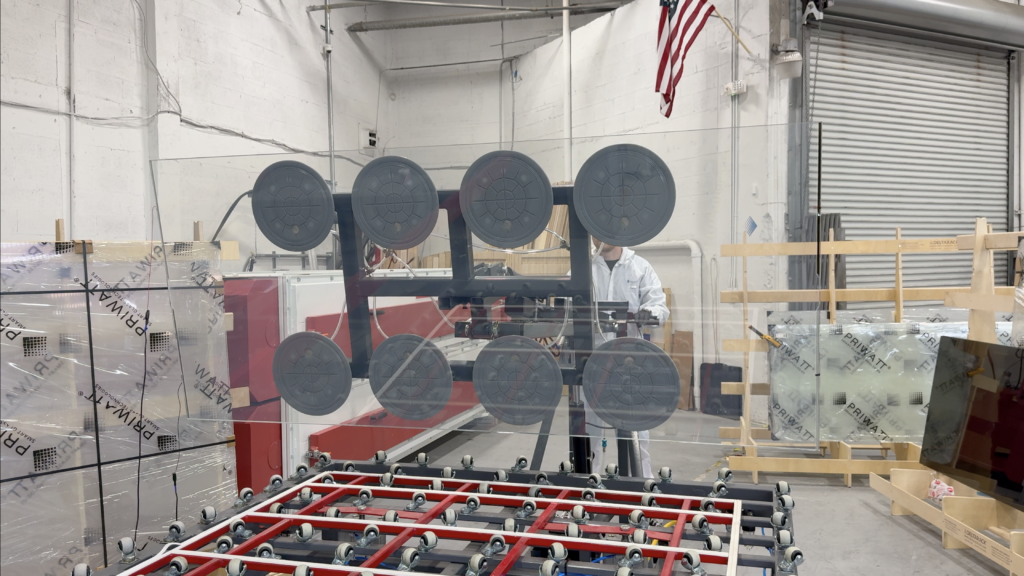
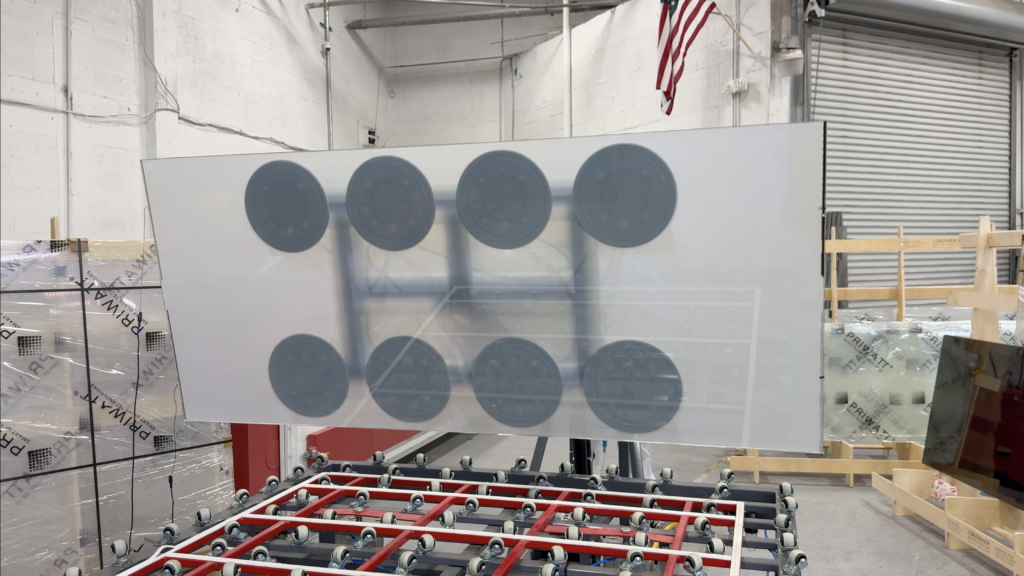
One of PNLC’s key advantages is its design flexibility. PriWatt PNLC glass is available in White, Grey, and Bronze tones, allowing the glass to better integrate with a project’s material palette—even in its opaque (ON) state. This provides a more controlled and refined appearance compared to standard PDLC, which is typically limited to a white, diffused look.
PNLC Highlights
- High optical clarity in transparent (OFF) state
- Reduced haze compared to standard PDLC
- More uniform and controlled appearance in privacy mode (not milky)
- Reverse operation (clear when OFF, opaque when ON)
- Fast switching response
- Lower power consumption compared to PDLC
- Available in White, Grey, and Bronze tones
Best Suited For
- Offices, meeting rooms, and conference spaces
- Residential interiors and modern homes
- Educational facilities and training environments
- Medical and healthcare settings where a cleaner glass appearance is preferred
- Premium commercial interiors where design matters
- Luxury hotels and high-end hospitality projects
- Projects requiring coordinated glass tones (Grey, Bronze, White)

OFF – Transparency
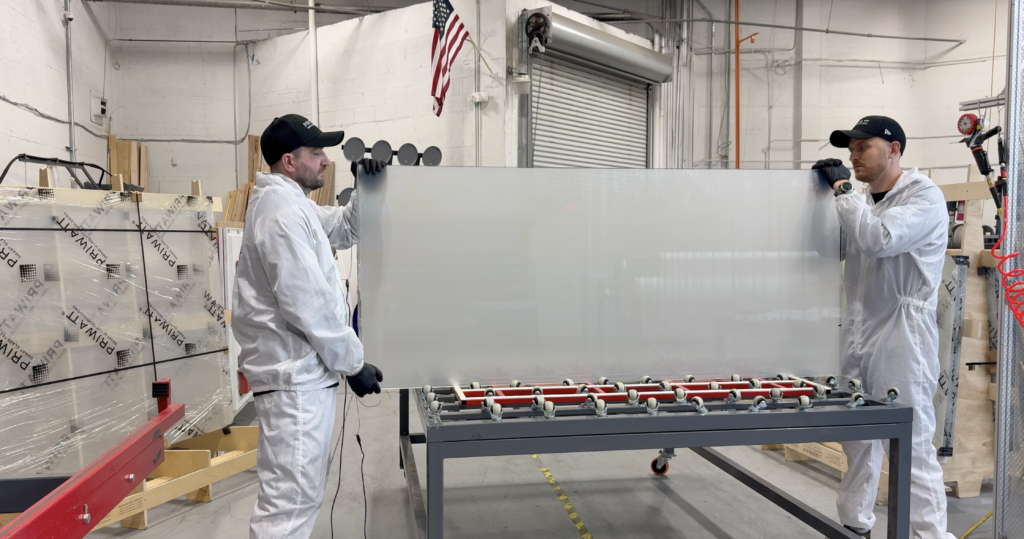
ON – Privacy
→ Learn more about PriWatt Reverse Switchable PNLC Glass: smartglasstech.com/reverse-switchable-glass
PriWatt — PNLC Smart Glass Manufacturer
Delivering advanced switchable glass solutions for architectural applications in the United States
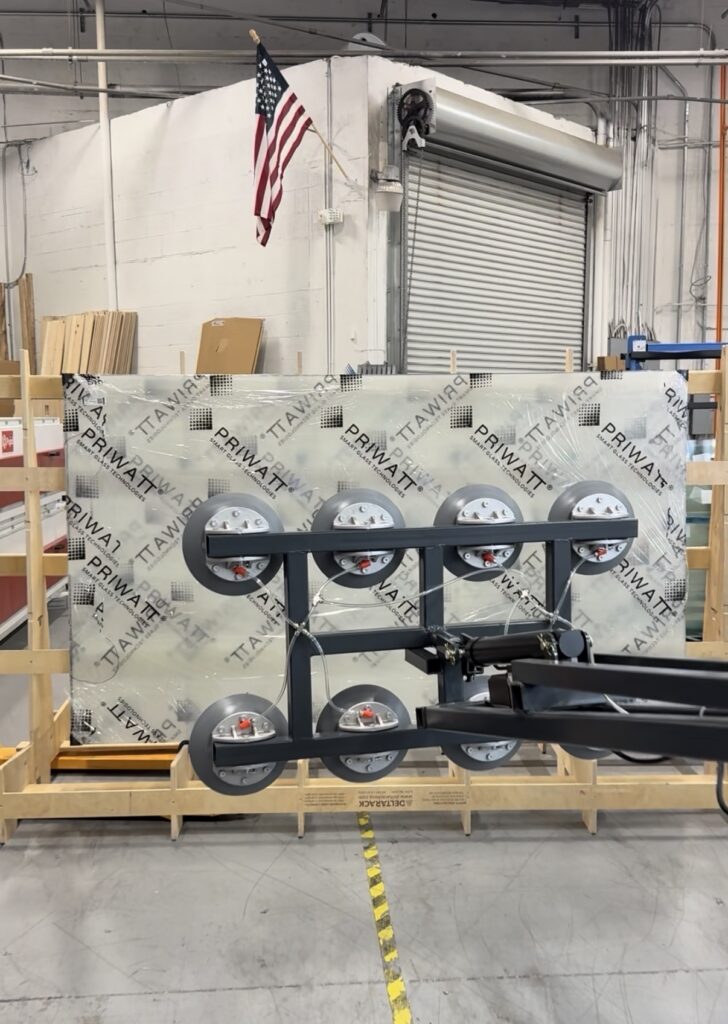
When it comes to PNLC smart glass in the United States, PriWatt is focused on delivering high-quality, project-ready solutions for architects, designers, and glazing professionals. The company has played a key role in bringing PNLC technology into real-world commercial and residential applications.
Unlike many suppliers that rely entirely on overseas production, PriWatt manufactures its glass systems domestically, providing better control over quality, more consistent lead times, and direct technical support throughout the project.
PriWatt specializes in laminated PNLC glass systems designed for new construction and custom interior applications, where performance, clarity, and visual consistency are critical.
Why PriWatt
Made in the USA
Domestic production for consistent quality and reliable lead times
Laminated Glass Systems
Designed for integration into architectural glazing projects
PNLC-Focused Technology
Specialized in reverse switchable glass solutions
Technical Support
Direct support for specification, fabrication, and installation
— ✦ —
The Bottom Line
The Bottom Line
Both PDLC and PNLC are proven smart glass technologies — each designed for different types of applications.
The key is choosing the right system based on project goals, not just price.
PDLC remains a widely used solution for standard privacy applications. It offers strong light diffusion and is commonly used in offices, healthcare environments, and retrofit projects where flexibility and cost efficiency are important.
PNLC, however, represents a more advanced approach. It provides clearer transparency, reduced haze, and a more controlled, refined appearance in privacy mode. The glass also remains clear without power, making it more aligned with how spaces are used in real-world conditions.
For projects where visual quality, consistency, and design integration matter, PNLC is often the preferred solution.
Need Help Choosing the Right System?
If you’re working on a project and want to specify the right system from the start:
👉 Request a Quote: https://www.smartglasstech.com/quote
📞 Call: (833) 333-8556